Newsletter
Volume 8, No. 1, May 2002
Editors: Teresa Alpuim and Bronwyn Harch
In This Issue:
1. A Message from the President.
2. TIES News.
3. Environmetrics Conferences.
4. Forthcoming papers in Environmetrics.
5. Environmetrics Forum.
6. Research Projects and Programmes.
7. Recently Published Books.
8. Book Reviews.
9. TIES Board of Directors.
1. A Message from the President,
Sylvia R. Esterby
This issue of the Newsletter will be received shortly before the TIES 2002 conference in Genova. I look forward to the second TIES conference in Italy with much anticipation, recalling the very successful TIES conference in Tremezzo in 1990. We will have a program which highlights current and extremely important issues in our plenary lectures, i.e. climate change, ozone depletion and risk due to toxic substances, and which covers a broad range of other topics. It is in keeping with the interdisciplinary, international and collaborative aspects of TIES. The wonderful location and gracious hosts make me confident that all the components are in place for a memorable conference.
The summary of the Annual General Meeting held at TIES 2001 conference in Portland is given in this issue. At that meeting, the Board announced measures intended to make payment of membership dues more convenient and to make membership more accessible. I am happy to report that the new payment options for regular membership have been chosen by some individuals. An initiative is underway by the Membership Committee to introduce to potential institutional members the favorable new combinations of individual memberships that are possible with an institutional membership. The awards committee will also have announcements for the Genova conference.
The Call for Nominations from the Election Committee, which was distributed to members, is included below. We attempted to send this by email to all regular members on April 12, 2002. When an email address failed we followed up with either a corrected email address or sent the message by airmail. If further nominations are received from the membership, elections will proceed during the summer to be completed before the beginning of the new term of office, September 1, 2002.
We have envisioned TIES Newsletter as another avenue, together with the journal and conferences, for the development of the field of Environmetrics and for the nurturing of the activities of Environmetricians. We see that the objectives, as set out at the end of the Newsletter, are developing more fully with each issue. I think that I speak for more than myself when I say to the individuals who have provided items giving news or their views, that we have enjoyed and benefited from reading their contributions. Our numbers are still not large and we are widely dispersed, but we can get to know each other through vehicles such as TIES Newsletter.
Related to the topic of the large distances between many of us, is the challenge that this brings to organizing annual conferences and to maintaining an adequate membership base. The organization of a TIES conference is a task that differs from the organization of a national scientific conference where there is a well-identified group which, with some regularity, can count on getting together. TIES conferences rotate among the regions so we can truly have an international role. This means that we have participants from the Environmetrics community local to the conference site and the ongoing stable group of participants, who are often able to travel to the conferences. The intent is that the conference benefits the local Environmetrics community and we would expect that the Society would also gain members from the region. For various reasons, the latter has not always happened. The initiatives of the Board regarding membership are a step in the direction of making TIES membership more accessible to the broader international community since a larger membership base would be needed to permit TIES to offer full membership benefits at preferential rates to regions where current rates are prohibitive.
The many ways that TIES members have been involved in the various activities that the Society has undertaken is the essential ingredient for success. The related issues of conferences and membership will be discussed again in Genova to obtain your input and support. But recognizing that many of you will not be attending, I would like to invite you to pass along your ideas to a member of the Board so that they can be taken into consideration during the discussions. This of course pertains to any topic that you would like the Board to consider.
Sylvia Esterby (sresterby@okanagan.bc.ca)
2. TIES News
2.1. New Members,
Francis Philbert
Welcome to the 4 new members who have joined since November 2001. Conferences, the web page and promotion of TIES by current members continue to be the major means by which individuals are learning about the Society.
Barnes, Mary B. Australia
Bates, Samantha Dr. USA
Fattorini, Lorenzo Italy
Mori, Sylvia R. USA
____________________________________________
2.2. Member's News
2.3. Society News
TIES 2002 Annual General Meeting
The president of The International Environmetrics Society, Sylvia Esterby,
announces that the Annual General Meeting will be held at the TIES 2002
conference in Genova, Italy after the technical sessions on Wednesday,
June 19.
Minutes of the 11th Annual General Meeting of The International Environmetrics Society (TIES).
Jari Walden, Secretary of TIES
Date: Tuesday, August 14, 2001, at 18.00
Place: Hotel Hilton, Portland, USA
Present were Sylvia Esterby, Francis Philbert, Peter Guttorp, Elena Naumova, Mohammed A. El-Saidi, Michael R. Stoline, Alessandro Fasso, Teresa Alpuim, Bronwyn Harch, Eduardo Severino, Ivana Spadafora, Ian B. MacNeill, Abdel El-Shaarawi, Krishna Jandhyala, Anders Grimvall, Eric Smith, Steve Stehman, Jean-Yves Pip Courbois, Ivanka Horova, Christina Yap, David Dolan, Ron McRoberts, Don Stevens, Rick Katz, Tony Olsen, Zohel Khalil, Paul D. Sampson, Daniela Cocchi, Carlo Trivisano, Ray Correll, David Jensen, Sarah Hession, Loveday Conquest, G. P. Patil, and Jari Walden.
Opening of the meeting: Sylvia Esterby, president of the society, opened the meeting and welcomed all the members.
1. Approval of the Agenda: The Agenda was distributed to the members at the meeting. No changes were proposed. Motion to approve the agenda was made by Mohammed A. El-Saidi and seconded by Abdel El-Sharaawi.
2. Approval of the minutes of the Annual General Meeting in Sheffield UK, September 5, 2000: Tony Olsen noted some misspelling in the names of the attendees. Since last meeting a membership committee was formed. No other changes or information for the agenda of the previous meeting was made. Abdel El-Shaarawi made the motion to approve the minutes. Ian MacNeill seconded.
3. Business arising from the minutes of the 2000 Annual General Meeting: No other business arose.
4. Report of the President: Sylvia Esterby gave the report. She concentrated on the present state of the Society, the Conferences, the Journal, and the Newsletter. She informed that the topics were also discussed at the Board meeting. Also a number of significant advances have been made or are in progress on 4 major fronts: Membership; Improving communication and publicity; Strength through working with other societies; and Taking stock and organizational procedures.
Some actions proposed to make payment of membership dues easier are: to bring the VISA card as an option for paying the membership fee, to include additional options for paying regular membership dues, and to allow flexibility in individual memberships which will be permitted with an institutional membership. The By-laws of the Society allow for Regular members, Student members and Institutional members. The idea was to offer more options like Regular retired, and include the possibility to pay fees for multiple years or for lifetime.
Since the last Annual Meeting a membership committee has been formed, which will have a two-year term, and the first chair of the committee is Peter Guttorp.
A draft version of the Society brochure was produced by Eric Smith and a final version will be worked out in the near future. The web pages are under renewal: more informative, more up to date, and a more effective tool for promoting TIES. It was recognized that the society needs someone to make the commitment of a significant amount of time to do this. Paul Sampson has agreed to do it and the web site will be moved to University of Washington to facilitate this. The president also noted that Ali Hadi continues to maintain the list server TIES-L.
The Handbook of TIES is under preparation by the president. It will include information on how the Society operates, what are the objectives of TIES, who are the personnel, content of the By-laws etc. The Board has been revising the Handbook of Conferences prepared by Ray Correll. It contains all the relevant information on how to organize a TIES Conference.
The Board has established a Liaison and Outreach committee with Tony Olsen as chair. Sylvia Esterby reported also on co-operation with the other societies. There were no questions and nothing to add to the report.
5. Report from the Treasurer and appointment of the accounting firm to prepare the 2001 Financial Report: Francis Philbert acknowledged Ivana Spadafora who has been doing the bulk of the Treasurer’s work on his behalf. Before going into the report he announced the topic that was discussed at the BOD meeting to include VISA-card as an option to pay the membership fee. He will negotiate with the Bank to open the VISA account. He also mentioned about the difficulty when the direct bank transfer is used and if the sender does not provide him with the required information. He reminded to the attendance that when the direct bank transfer is used the sender must inform the treasurer, e.g. by email, who has made the transfer and the date of the transfer.
The Treasurer also announced that the financial report will be made in US$ instead of Canadian dollars. Most of the expenditures are also in US$. This will remove the problem of exchange rate adjustments when the financial report is prepared.
Francis Philbert reported on the review of the society expenses, capital, and revenue for 2000 by Scott, Batenchuk, & Co. LLP. The main income comes from the membership fees and the interest. The main expenses are the Journal of Environics, Newsletter, legal and accounting and currency change. The financial state of the society is fiscally sound.
Francis Philbert presented the financial status report for 2001 up to July 31, 2001 and the budget for 2002. The budget estimates for 2002 are made according to the same membership income as for the 2001: 130 regular members, 80 members not subscribing to the journal, and 10 student members. By July 31, 2001 there is still some way to go to reach the budget estimates for this year. However, the difference between the revenue and the expenses is positive. The treasurer opened the forum for discussion and for acceptance of the budget. During the discussion Tony Olsen noted that the bank account costs for using the VISA- and MasterCard will increase. The BOD was aware of this but also assumed that VISA option will bring new members. There are still other options like checks, which are used quite frequently especially in North America. The cost for the Newsletter was noted by El-Saidi and he suggested the use of the web pages instead of a hard copy. Abdel El-Sharaawi supported the hard copy version and considered it good for the Society. It was proposed that a pdf-version of the Newsletter on the web page is a good option but that the hard copy version is sent to the members. The treasurer made no other comments on report.
The Treasurer made a motion to retain Scott, Batenchuk & Co. LLP as accountants. Abdel El-Shaarawi and Ian MacNeill seconded the motion. The vote was unanimous.
6. Membership report: Francis continued by presenting the membership of TIES, both as total and divided geographically. The number of members (July 31, 2001) is 169 of which 158 are regular members, 11 student members, and 3 institutional members. The total membership has increased by 6 since the last meeting.
Peter Guttorp reported on the membership committee and stated that institutional members, e.g. universities, are a nice way to increase the number of students who may later become regular members. It was also discussed if the membership list should be available on the web site, but a danger was seen that it would end up on the junk mail list.
7. Newsletter: The editor of the Newsletter, Teresa Alpuim, made the presentation. She thanked everybody for contributing to the Newsletter, especially the BOD had been active for the latest issue. She said that there should be more discussion of theoretical work and presentation of research projects in future newsletters. TIES regional news needs more work and she expressed the wish that the regional members would contribute more intensively as this would be of great interest for the other members.
It was suggested that the members should be encouraged to contribute and regularly informed of the dead line for submitting contributions to the Newsletter and of the date when it is going out. Abdel El-Shaarawi thanked the editors of the Newsletter and considered that they do valuable work for the society.
8. Conferences: Tony Olsen gave a report of the ongoing conference. There are 135 participants from 16 different countries. Co-sponsoring of the other societies has been good. The registration fee should cover all the expenses and support to the society. There were 35 new membership forms received during the conference of which 20 were with the Journal. Tony thanked all the attendees. Abdel El-Shaarawi thanked Tony and the local organization committee for all the work for making the conference a reality.
Sylvia presented the brochure for the next conference to be held in Genoa, Italy during 18 – 22 June, 2002. Daniela Cocchi, from the local organizing committee, informed that it is important to have as many early registration as possible. She noted that the currency will be EURO. The conference brochure will also be in the web and it will be updated frequently. During the conference special sessions are organized and she welcomed all the help from the members. Ian MacNeill wished that payment by VISA card would be an option in the registration form.
9. Awards: Francis Philbert informed the attendees of his motion tabled at the BOD meeting the previous day. He read the motion: "Whereas I vividly recall Abdel (along with Ian MacNeill and others) pioneering efforts in initiating and organizing the first TIES conference held in Cairo, Egypt, April 4-7, 1989; And whereas Abdel has been the Society’s president from its inception until 2000, with his name becoming synonymous with the acronym "TIES"; And whereas Abdel has done an outstanding job in shepherding the Society in its formative years and he has been instrumental in establishing it as the stable and well recognized society that it is today; I move that as a fitting recognition of, and show of appreciation for, Abdel’s outstanding contribution and dedication to TIES, he be honored by our establishment of an annual award or lectureship in his name"
The BOD unanimously agreed to the motion at their last meeting and will come up with a suggestion for an appropriate award at the next meeting. Abdel El-Shaarawi expressed his appreciation for the motion and thanked everyone for all their work.
10. Environmetrics Journal and Encyclopaedia: Abdel reported that the hard copy of the Encyclopedia is ready. Many contributions by the members of the society are included and he was thankful for the work that has been done. Abdel informed that the Encyclopedia will be out in October 2001. There will also be an electronic version, which makes it possible for anyone to contribute in the future. At the end he thanked the authors for their contribution to this demanding task.
Peter Guttorp suggested that the society could buy a bulk number of copies of the journal at reduced price, and that this issue was discussed with Wiley.
Abdel continued with the Journal. He considered that the Journal should have deep connection to the members of the society. The Journal is moving well and members were encouraged to continue to submit papers. He also said that he will have more time for the editorial work now that the Encyclopedia is ready.
11. Liaison with other societies: Sylvia presented the co-operation with different societies and conferences. Abdel announced that the ISI 2003 conference contacted to him provide an Environmetrics session. Peter reported that there was no plan by the ISI Environmental Statistics Committee to put forward a proposal to form a section at the conference in Korea later in August. No other comments.
12. 2002 elections: Sylvia Esterby reminded the members that TIES BOD elections will take place in 2002.
13. Other business: No other business arose. Abdel made the motion
to end the meeting. Ivana Spadafora seconded. The meeting ended at 8.30pm.
The following is the call for nominations that has previously been sent to TIES members by email, or when that was not possible by airmail.
2002 Election of Board of Directors of the International Environmetrics Society (TIES)
List of Nominations and call for further nominations
Elections are held every two years. Officers are elected for two year terms and Regional Directors for four year terms, which in this election will be 01/09/02 – 31/08/04 and 01/09/02 – 31/08/06, respectively. The terms of the Regional Directors are staggered so that only one Regional Director from each Region is elected in a given election. The following Directors continue on the Board for the indicated terms:
President : President-Elect, Peter Guttorp (USA), becomes President (01/09/02 – 31/08/04)
Regional Representatives (01/09/00 - 31/08/04):
North America: Anthony R. Olsen, USA
Europe: Daniela Cocchi, Italy
Other Regions: Raymond L. Correll, Australia
LIST OF NOMINATIONS
The Election Committee submits the following list of nominations for the seven positions for election in 2002:
President-Elect: Anders Grimvall,
Linköping University, Sweden
Secretary: Richard W. Katz,
Nat. Cent. for Atmos. Res., USA
Treasurer: Bronwyn D. Harch,
CSIRO, Australia
Public. Officer: Teresa Alpuim,
Universidade de Lisboa, Portugal
Regional Representatives:
North America: Jeanette O’Hara Hines,
University of Waterloo, Canada
Europe: Gudmund Host,
Norwegian Comp. Cent., Norway
Other Regions: Jacky Galpin,
Univ. of Witwatersrand, South Africa
CALL FOR FURTHER NOMINATIONS
The Election Committee invites Members of The International Environmetrics Society to submit nominations for the positions of the Board of Directors of TIES.
To be eligible to be a Director, an individual must have been a Regular Member for the two year period immediately preceding such individual’s election or appointment as a Director. Since membership is recorded on the basis of the year, to be eligible in this election, an individual must be a current Regular member who has been a member during 2000/01.
A nomination for the position of President-Elect, Secretary, Treasurer or Publications Officer must be supported in writing by at least five Regular Members in good standing. A nomination for Regional Director must be supported in writing by at least five Regular Members in good standing from the nominated individual's region. An individual's region shall be the region in which he or she normally resided on February 1, 2002. A brief biographical sketch should accompany each nomination.
Nominations must be received by the chair of the Election Committee, Sylvia Esterby, by 4PM Canadian Pacific time Friday May 24, 2002. They may be sent by regular mail, by fax or by email.
Election Committee: Ray Correll, Sylvia Esterby, Marian Scott
Send nominations to:
Dr. S.R. Esterby
TIES nominations
Department of Mathematics and Statistics
Okanagan University College
3333 College Way
Kelowna, BC
Canada V1V 1V7
Telephone: (250) 762 5445 ext 7536
Fax : (250) 470 6004
Email: sresterby@ouc.bc.ca
NOTE: Include TIES nominations on the envelope if sent by mail or on the cover page if sent by fax
If you wish to stand for election or to nominate a candidate and have not renewed your membership, you should do so before the nomination is sent to the chair of the election committee. You will have received a renewal form in the mail late in 2001. You may also go to the TIES web page,
http://www.nrcse.washington.edu/ties
to obtain a copy of the appropriate form.
Mail membership forms and payment to TIES Treasurer, Francis Philbert.
3. Environmetrics Conferences
3.1. Forthcoming TIES Conferences
TIES 2003, Beijing, China
In conjunction with Third International Conference on Contaminants in the Soil Environment in the Australasia-Pacific Region, the 13th Meeting of TIES will be held at the Beijing Friendship Hotel during 21 - 25 August 2003.
The Organising Committee for TIES2003 is:
Ray Correll Ray.Correll@csiro.au (co-chair)
Jingzhu Zhao jzhao@mail.rcees.ac.cn (co-chair)
Bronwyn Harch Bronwyn.Harch@csiro.au
Yongguan Zhu yongguan.zhu@adelaide.edu.au
Quanxi Shao Quanxi.Shao@csiro.au
Ming Wong mhwong@hkbu.edu.hk
Xuliang Zhuang xlzhuang@mail.rcees.ac.cn
A First Announcement and Call For Papers brochure will be available
after the TIES2002 conference (outlined above). For further details about
the conference or suggestions concerning technical topics for the scientific
programme please contact Ray.Correll@csiro.au
TIES 2002, Genoa, Italy,
Daniela Cocchi
TIES 2002 Conference will be held in Genoa, Italy, June 18-22, 2002. Detailed information about the conference is available on the conference web site: http://www2.stat.unibo.it/ties2002/.
The Scientific Program committee is finalizing the conference program of plenary, invited and contributed sessions. A preliminary program is available on the web site.
Prof. Lennart Bengtsson (Max Planck Institute for Meteorology, Hamburg, Germany and Environmental Systems Science Centre, University of Reading, UK) will be the TIES President’s Lecturer. Prof. Bengtsson has a distinguished career in meteorology and climatology. The title of his lecture is "Is the Earth's climate changing?".
Prof. Noel Cressie (The Ohio State University, Columbus, OH) has been selected by the TIES Board of Directors to be the J. S. Hunter Lecturer at the conference. Prof. Cressie is one of the most experienced researchers in the area of statistical modeling and analysis of spatio-temporal data. He will give a talk with the title "The Ozone Hole: Spatial Trend in a Massive, Global Dataset".
Prof. Hans J. Pasman (Defence Research, Netherlands Organisation for Applied Research, Delft, the Netherlands) has been invited to give a plenary talk untitled "A Model for Structuring the Quantitative Assessment of Public Health and Environmental Risks of Toxic Substances" (co-author: Saul M. Lemkowitz, Faculty of Applied Sciences, Delft University of Technology, the Netherlands).
The conference includes invited sessions on: Methods for identifying and quantifying trends; Environmental indicators; Scale-invariance and scale-dependence in environmetrics; Statistical models for categorical data in air quality monitoring; Small area inference in environmental problems; Statistical assessment of large computer models; Climate and statistics; Risk assessment; Sampling in state and national level monitoring programs; Spatial and temporal modelling of environmental processes; Remote sensing; Statistical issues in air pollutant emissions inventories; Linear, mixed linear and dynamic linear models in environmetrics; Bayesian model comparison and model averaging; Sensitivity analisyis.
A short course will be given on Sunday – Monday, June 16 – 17. The course is on "Estimation of human impact on the environment" and is organized by Anders Grimvall (Linköping University, Sweden), coordinator ofthe EU project IMPACT (Estimation of human impact in the presence of natural fluctuations).
TIES sponsors a short course on "Spatial methods in Environmental Epidemiology". The course will be given on Sunday – Monday, June 16 – 17 and it is organized by IST (Istituto Nazionale per la Ricerca sul Cancro - Genoa).
The conference organizers are:

3.2. Other Forthcoming Conferences
A three-day conference entitled "Spatial Statistics: Integrating Statistics, GIS, and Statistical Graphics," to be held October 17-19, 2002, in Seattle, Washington, U.S.A., is being organized by the Statistics and Environment Section of the American Statistical Association (ASA) and the National Research Center for Statistics and the Environment. There will be a one-day short course on October 17th. A workshop will begin Friday, October 18th, and extend until noon, Saturday, October 19th. Papers will be given on recent advances in the analysis and display of environmental spatial data.
Short Course, Thursday, October 17th: Integrating Geostatistics and GIS by Jay Ver Hoef and Konstantin Krivoruchko.
The morning will consist of an introduction to the ideas of geostatistics. The fundamentals of geostatistics will be demonstrated using the Geostatistical Analyst (GA), which is an extension to ArcInfo/ArcMap. In the afternoon, the short course will be a PC lab for hands-on instruction using GA. Although data will be available, participants are encouraged to bring their own data. In addition to the short course leaders, several other experts in geostatistics and knowledgeable GA users will be available to give individual attention to participants during the afternoon lab. Due to the capacity of the lab, enrollment is limited to 26 so it is important to register early! Registration for the short course is $350 for members of ASA's Section on Statistics and the Environment and $375 for nonmembers.
Workshop, Friday, October 18 to 19th: Spatial Statistics: Integrating Statistics, GIS, and Statistical Graphics.
The workshop will consist of a series of invited presentations on research topics at the interface of statistics and GIS. Research leaders will give topical presentations on Spatial Statistics and GIS, Spatial Sampling Design, Visualization, Change-of-Support, Agile GIS, and Environmental Applications. Ample time will be provided for a thorough discussion of the topics. Registration for the workshop is $175 for members of ASA's Section on Statistics and the Environment and $200 for nonmembers.
For further information, please contact Linda J. Young at LJYoung@unl.edu or check the Section on Statistics and Environment web site
The Modelling and Simulation Society of Australia and New Zealand will be holding their next bi-ennial congress, MODSIM 2003 in Townsville, Queensland, Australia from 14 to 17 July, 2003. Information on the Congress can be found on the following webpage :
http://mssanz.cres.anu.edu.au/modsim2003.html
The first Biennial meeting of the International Environmental Modelling and Software Society will be held in Lugano, Switzerland from June 24-27, 2002, http://www.iemss.org/iemss2002. The Society (iEMSs) is an umbrella group linking various interests including those working on modelling, software systems, multiobjective decision support and innovative methods such as artificial intelligence. The theme of the Lugano meeting is "Integrated Assessment and Decision Support".
The topics covered by the conference include:
The International Workshop, Perspectives in Modern Statistical Inference II, will be held from 14 to 17 August in Brno, the center of Moravian Region. It is organized jointly by the Department of Probability and Mathematical Statistics of Charles University in Prague, the Department of Applied Mathematics of Masaryk University in Brno and the Union of Czech Mathematicians and Physicists.
The workshop is a satellite to the 24th European Meeting of Statisticians, taking place from 19 to 23 August in Prague and follows the successful First Workshop on Perspectives in Modern Statistical Inference: Parametrics, Semiparametrics and Non parametrics, organized in Prague in 1998.
The workshop will focus on recent results in parametric, semiparametric and nonparametric statistical inference presented by outstanding specialists in the area, namely, P. Chaudri (India), M. Csörgo (Canada), P. Deheuvels (France), P. Greenwood (Canada and USA.), L. Horváth (USA), A.M. Kagan (USA), C.A.J. Klaassen (The Netherlands), R. Koenker (USA), B. Levit (Canada), D.M. Mason (USA), H. Oja (Finland), S. Portnoy (USA), P.K. Sen (USA) and J.A. Wellner (USA).
For more information about the workshop contact the local organizer:
Ivana Horová, Department of Applied Mathematics, Janáckovo
nám. 2a, CZ – 662 95 Brno, Ccech Republic. E-mail: horova@math.muni.cz.
Fax: +420 5 4121 0337. Phone: +420 5 4132 1251.
The Third Conference on Artificial Intelligence Applications to Environmental Science, sponsored by the American Meteorological Society, and organized by the AMS Committee on Artificial Intelligence Applications to Environmental Science,
(http://polar.ncep.noaa.gov/ams), will be held 9-13 February 2003, as part of the 83rd AMS Annual Meeting in Long Beach, California. Hotel information will be posted, in Spring 2002, on the AMS Web site at
Preliminary programs, registration, and general information will be posted in mid-September 2002. Papers for this conference are solicited on all aspects of artificial intelligence applications to environmental sciences. To reduce the need for parallel sessions, the majority of the presentations in each conference and symposium will be scheduled as a poster. Abstracts should be submitted electronically via the Web by 15 July 2002. For instructions, refer to the AMS Web page at
For additional information please contact the program chairperson, Vladimir Krasnopolsky, Environmental Modeling Center, NCEP/NWS/NOAA, 5200 Auth Road, Camp Springs, MD 20746 (tel: (301) 763-8000 x 7262; fax: (301) 763-8545; e-mail:
3.3. Other Related Events
Marmap System Partnership
G.P.Patil
Distinguished Professor and Director
Center for. Stat. Ecology and Environmental Statistics
Dept. of Statistics, The Pennsylvania State Univ., USA
Geospatial data form the foundation of an information-based society. Consider a 21st Century digital government scenario of the following nature: What messages do multicategorical thematic maps and cellular surfaces have about the large landscapes they represent? And at what scale and at what level of detail?...Does the spatial pattern of the map reveal any societal, ecological, environmental condition of the landscape? And therefore can it be an indicator of change?...How do you automate the assessment of the spatial structure and behavior of change to discover critical areas, hot spots, and their corridors?...Is the map accurate? How accurate is it? How do you assess the accuracy of the map? Of the change map over time for change detection? What are the implications of the kind and amount of change and accuracy on what matters, whether climate change, carbon emission, water resources, urban sprawl, biodiversity, indicator species, or early warning? And with what confidence, even with a single map/change-map?
A primary purpose of MARMAP System Partnership is to develop sound methodology and appropriate software for the quantitative analysis and interpretation of multi-categorical maps and cellular surfaces (inferential geospatial informatics) involving landscape pattern analysis, multiscale landcover landuse change detection, accuracy assessment, critical area detection and delineation, disease mapping and geographic surveillance, prioritization and ranking without having to integrate multiple indicators, and a few more. It will be nice to see you participate in one capacity or the other. The following websites give recent publications together with some relevant exciting events.
Please feel free also to share this material with your potentially interested friends and colleagues.
1. MARMAP and MARMAP Prospectus 1,2,3,4,5,6,7.
Website: http://www.stat.psu.edu/~gpp/newpage11.htm
2. Multiscale Advanced Raster Map Analysis System: Definition, Design, and Development. Invited Paper for Joint Statistical Meetings (New York City), Portuguese Statistical Congress, International Environmetrics Society, Brazilian Ecological Congress, and Italian Ecological Society. Website:
http://www.stat.psu.edu/~gpp/PDFfiles/TR2002-0203.pdf
3. Project MARMAP System Partnership Collaboration with EPA STAR Grant Atlantic Slope Consortium for Development, Testing, and Application of Ecological and Socioeconomic Indicators for Integrated Assessment of Atlantic Slope in the mid-Atlantic states. Website:
http://es.epa.gov/ncer_abstracts/grants/00/envind/brooks.html
4. Project MARMAP System Partnership Collaboration with UNEP
Division of Early Warning and Assessment on Human Environment Index based
on Countrywide Land, Air, and Water Indicators.
Website:
http://www.stat.psu.edu/~gpp/current_events.htm
5. Project MARMAP Show and Tell Seminar series: EPA ORD NCEA,
EPA ORD NERL, EPA OEI, NASA HQ, NASA GSFC, NCHS, NYSDEH; UMD, GWU, UCB,
MSU, UM, SUNY SPH.
Website (Powerpoint Presentations):
http://www.stat.psu.edu/~gpp/powerpoint.htm
6. Ecosystem Health and Its Measurement at Landscape Scale: Towards the Next Generation of Quantitative Assessments. Invited Paper for Ecosystem Health, International Society for Ecosystem Health. Website:
http://www.stat.psu.edu/~gpp/PDFfiles/TR2002-0202.pdf
7. Multiscale Advanced Raster Map Analysis System for Measurement
of Ecosystem Health at Landscape Scale: A Novel Synergistic Consortium
Initiative. Invited Paper for Managing for Healthy Ecosystems, International
Society for Ecosystem Health.
Website: http://www.stat.psu.edu/~gpp/PDFfiles/TR2002-0301.pdf
8. Washington DC Conference on Linkages Between Biodiversity, Ecosystem Health, and Human Health, June 6-11, 2002. A Special Session on Ecosystem Health and Its Measurement at Landscape Scale. June 10, 10:00AM - 12:00Noon. Website:
http://www.stat.psu.edu/~gpp/current_events.htm
9. Joint Statistical Meetings on Statistics in Era of Technological
Change, August 11-15, 2002, New York City. A Special Session on Multiscale
Advanced Raster Map Analysis System for Digital Government in the 21st
Century. August 13, 2:00PM - 3:45 PM.
Website: http://www.stat.psu.edu/~gpp/current_events.htm
10. Short Course and Research Workshop on Multiscale Advanced Raster Map Analysis System for the Map of Italian Nature, University of Parma, Parma, Italy, June 21-22, 2002. Website:
http://www.stat.psu.edu/~gpp/current_events.htm
Environmental Data Seminar At Ohio State University, by Noel Cressie, Ohio State Univ., USA
In 2001 and 2002, the Statistics Department's Program in Spatial Statistics and Environmental Sciences* (SSES) ran a highly successful interdisciplinary seminar that featured data from environmental science and engineering problems. Speakers were Ohio State University (OSU) faculty and staff, and the seminars were advertised widely throughout campus and to interested parties in Ohio.
The setting was informal and there was always a lot of discussion during and after the talks. Refreshments and snacks were served before the talk and proved to be a popular feature of the seminar. Logistic arrangements were co-ordinated by Noel Cressie and Program Assistant, Terry England, and the help of all members of the SSES Program was important for its smooth running. The Seminar was sponsored by both the Department of Statistics and the College of Mathematical and Physical Sciences at OSU.
Of the total of 18 seminars given, the following units were represented: Agricultural, Environmental and Development Economics; Byrd Polar Research Center; Chemistry; Civil and Environmental Engineering and Geodesic Science; Food, Agricultural, and Biological Engineering; Geography; Geological Sciences; Public Health; School of Natural Resources; and Statistics. Topics ranged in scope from being global (carbon sequestration; sea level rise), to continental (Antartica's ice sheet), to regional (land use in the Midwest), to local (long-term wetland experiment), to microscopic (chemistry and pollutant interaction of natural organic matter). For details on the 2002 Environmental Data Seminar, go to the web site:
4. Forthcoming Papers in Environmetrics
5. Environmetrics Forum
The Environmental Statistician as Environmental Project Coordinator
Ray Correll and Bronwyn Harch
CSIRO Environmental Measurement
and Assessment
INTRODUCTION
The objective for The International Environmetrics Society, as stated on its web page is
‘to foster the development and use of statistical and other quantitative methods in the environmental sciences, environmental engineering and environmental monitoring and protection.’
This article examines some aspects of the way environmental statisticians operate, and makes a case for the environmental statistician to have a more coordinating role in environmental projects.
AVAILABLE OPTIONS FOR
ENVIRONMENTAL STATISTICIANS
There are several options for environmental statisticians. Some are listed below. In practice the boundaries between the groups merge, and in other cases the same statistician may be operating in several different ways.
Pure statistician approach
This is a common mode of operation for research students. New theory is developed, and perhaps tested on simulated data. Such an exercise may develop to the point where the theoretical statistician hunts for data sets where the new theory can be applied. Unfortunately, real life problems often don’t fulfil all the assumptions, so the work is published based on simulated data only.
Statistical Add on
This usually occurs late in the project when the researchers, having collected data, do not know how to analyse it. Some extreme cases of this are when a paper has been rejected, or flaws in the design have meant that the analysis is non-trivial. Such situations are less than ideal scientifically. Typically at this stage of a project, all funds have been used so the statistician is expected to work a miracle and not get paid for it.
Full collaborator
The full collaborator role is a more fulfilling position. In this situation the statistician will be a full member of the research team. This may involve helping to write the research proposal. It may imply that the statistician has a separate budget in the project. The statistician in this situation has a role in the project planning and must take on some of the project responsibility. The full collaborator role is often the best option for a statistician.
Project leader of environmental studies
In this role, the environmental statistician would have the primary responsibility for the environmental project. This role would include formulating the research proposal and bidding for its funding, team management and eventually production of the final report. The environmental statistician as the leader of an environmental team is an extreme position. However a case for this is made in the following section.
TYPICAL ENVIRONMENTAL PROJECT
The typical environmental problem has a series of phases. The phases
include scoping and defining the problem in quantitative terms, literature
searching, sampling, laboratory studies, data analysis, synthesis of the
findings, and then formulating the findings. These facets of the problems
are described in the following table.
Components Skills required
1. Scoping the problem Ecologists, Planners
2. Literature Searches Chemists, Biologists,
Environmentalists
3. Sampling, monitoring Chemists, Physicists,
Biologists
4. Chemistry, Physics, Biology
5. Data analysis Computing
6. Synthesis, evaluation Ecologists, Planners
7. Recommendations Ecologists, Planners
Purpose of component
1. Expressing problems in quantitative terms
2. Evaluating and compiling previous work
3. Design of experiments and monitoring systems
4. Assessing quality of the data/calibration
5. Analysis for scientists and clients
6. Interpretation and evaluation
7. Presentation of results
OBSERVATIONS ON ECOLOGICAL TEAMS
Large and diverse teams are commonly required
Many ecological problems require a range of skills and equipment. The team may include inter alia ecologists, sociologists, eco-toxicologists, chemists, lawyers and the statisticians. Different projects require a different mix of skills, so different teams need to be assembled for different projects.
Statistician has a role throughout
Different phases of a project require different team members. The statistician is the only member of the team who has a role in all the phases of the project. The statistician therefore often works closely with more of the team members than any other scientist.
Statistician in best position to assemble team
Because the statistician works with a wider range of scientists than most other disciplines, the statistician has the potential of developing extensive networks of scientific relationships. The experienced environmental statistician is therefore in a better position than most other scientists to assemble a team with the required skills to undertake environmental projects.
Statistician in best position to lead team
The environmental statistician will have worked with scientists from many of the disciplines used in an environmental project, and will therefore have at least some understanding of the problems encountered. This understanding of the big picture places the environmental statistician in a good position to lead the team.
Responsible Scientist Approach
As statisticians, there is a tendency to play follow the leader, and to be a junior partner in scientific investigations. By taking this role, the statistician never becomes the senior partner, and so never takes responsibility. A more mature position is to be prepared to take (or at least share) the risks in the bidding process for major studies. This can only occur if the statistician is to play a leading role in the project.
PROFESSIONAL SURVIVAL
For survival of our profession, we need to stop the decline in statistics. One such way is to have the statisticians as close collaborators or as team leaders. This will be good both for statistics and for the areas in which it is applied. We will be more likely to attract good students if we can show that statistics is relevant, that it has impact on science and is very enjoyable.
CONCLUSION
There is a strong case for statisticians being equal partners or perhaps team leaders in ecological projects because the environmental statistician
Discussion,
Teresa Alpuim, University of Lisbon, Portugal
This article is a summary of a very interesting talk presented by Ray Correll and Bronwyn Harch at the TIES 2001 Conference in Portland. It provides an excellent platform from which to open a wider debate on a subject of utmost importance, namely, the role of statistics and quantitative methods in environmental research and monitoring programs. As co-editor of this Newsletter, I would like to encourage all members of TIES to participate in this discussion and invite them to send contributions to the newsletter sharing their opinions and experiences.
In the final part of Correll & Harch’s article an alert is given that "For survival of our profession, we need to stop the decline in statistics." One of the reasons given for this decline is the inability of many statisticians to be full or equal collaborators in environmental research projects. In the authors’ opinion this may happen because they are trained to operate either, in what they call, "the pure statistician" or "the statistical add on" approaches.
"The pure statistician approach" is a very common way of doing statistics at universities. It reverses the sensible way in which applied science should be undertaken. Instead of developing statistical theory to respond to the practical needs of solving real problems, this approach builds an intricate net of results too complex to be applied and, in many cases, based on assumptions some distance from reality. In fact, this way of developing statistical theory – which is equally applicable in others fields of applied mathematics – is more driven by the bureaucratic needs of academic careers and the need to secure research funding than by the role science can play as a contributor to the development of society. It is not my aim to be too critical towards many of our colleagues working honestly and hard in this perspective because scientists, like everyone else, are influenced by the cultural context in which they have to work and by the political strategies that fund their research.
"The statistical add on" approach corresponds, more or less, to the same deviation as "the pure Statistician approach", but now towards the perspective of a non-statistician scientist. Both ways of working reveal a reducionist view of science; not relating the particular subjects under study to other types of knowledge or not considering them in a broader understanding of science. In them, the individual interests of the researcher are confounded with the goals of scientific research. Clearly, to be a full or equal collaborator in a project is, in most cases, the most rewarding option for a statistician. I will now outline some reasons why this may not happen very often.
Losing sight of the main goal of science - the acquisition of knowledge relevant to the improvement of human life - the scientific community and their official sponsors have been developing strict and narrow guidelines for evaluating the results of research. Absurd quantitative criteria like the number of refereed publications, communications or citations are often employed without any consideration of the research quality, creativity or its impact or benefit to society. This loss of focus on the main goals of science has also contributed to the astonishing increase in the number of small specialist scientific disciplines that do not communicate with each other, but believe that each one is more important than the other. Such artificially created subdivisions of science may facilitate the hierarchical organisation of the academic world, as it is much easier and safer to be a specialist in a subject that few people understand than to be a generalist. These subdivisions are certainly an obstacle to the advance of interdisciplinary subjects like environmental sciences.
The study of life on Earth - in its broader sense - and of the processes that may disturb or impact it, involves complex relationships amongst several branches of science and requires the work of research teams including ecologists, biologists, chemists, physicists, statisticians, etc. Statistics is primarily concerned with the methods of science and, thus, relates to all areas of knowledge. Because of this, as Correll & Harch suggest, the statistician is in a privileged position to lead such teams. Of course, a statistician may not have – and should not feel compelled to have - the human qualities required to be a good leader. But they certainly should try to relate with all members of the team and be active in all phases of the project. In any case, all members of the group should understand the common objectives of the different components of the project and consequently fruitfully engage with the relevant project members whose expertise and knowledge is required for delivering a joint outcome during the project.
I find the leadership of this type of project very difficult because, as explained in previous paragraphs, the present scientific evaluation methods and funding system encourage individualism and competition and not teamwork and interchange of knowledge. In addition, this system also puts a lot of pressure on scientists and condition them to obtain a large number of results in quick succession. This contradicts the process of obtaining knowledge in the environmental and earth sciences, where a long period of time is needed to collect data that reproduce all different types of environmental conditions or to do the validation of results and theories with all the possible natural and social scenarios. However, research teams provide an ideal forum for the integration of various disciplines to conduct research on complex environmental systems. Often these projects are done in conjunction with the pressures of political, economic or an individual’s interests. Nonetheless, the scientific community has to make an effort so that these types of projects work independently of such interests and provide the sound scientific knowledge base for good decision making.
Summing up, I share the belief of Correll & Harch that statistics
has an important, if not leading, role to play in interdisciplinary environmental
research projects. These projects are vital to the advance of environmental
and earth sciences and, thus, also to the advance of statistical theory
and practice. Statistics will not survive as a subdivision of the academic
world, acting alone and not interacting with other sciences. Statisticians
need to show to members of the scientific community and the public the
immense societal gains possible when acquired data is interpreted and this
knowledge subsequently used for sound decision making. This has to be done
independently of political, economic, academic or any individual or small
group interests.
Forest Inventories In The United States
Ronald E. McRoberts
Thomas L. Schmidt
Katherine P. O’Neill
Patrick D. Miles
Gary J. Brand
North Central Research Station
USDA Forest Service
1992 Folwell Avenue
St. Paul, Minnesota 55108 USA
Introduction
The Forest Inventory and Analysis (FIA) program of the Forest Service, an agency of the U. S. Department of Agriculture (USDA), conducts inventories of the nation’s forest land to determine its extent and condition and the volume of standing timber, timber growth, and timber depletions. In response to user requests for inventories that are more timely, cover all forested lands, permit nationally consistent cross-state and cross-regional estimation, and facilitate environmental and ecological analyses, the FIA program has initiated an annual inventory system, designated Enhanced FIA. The Enhanced FIA program is administered and implemented nationally through five regional programs.
FIA sampling design and plot configuration
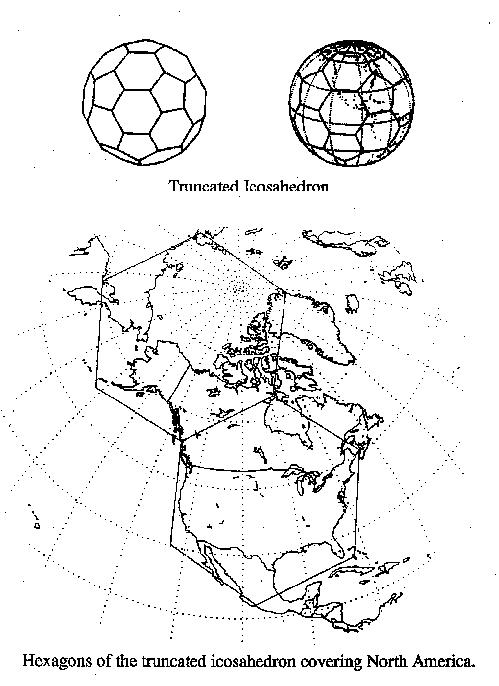
The national FIA sampling design was derived from the worldwide sampling array developed by the U.S. Environmental Protection Agency as part of the Environmental Monitoring and Assessment Program (EMAP). An underlying requirement of large area sampling arrays is coverage using regular polygons of constant shapes and sizes, regardless of latitude and longitude. White et al. (1992) covered the Earth’s surface with a truncated icosahedron, a system of 20 hexagons and 12 pentagons configured like the panels of a soccer ball (Figure 1). A base hexagon of the truncated icosahedron was placed over the conterminous United States and randomly offset from the cardinal directions.

Fig.1. The genesis of the FIA national sampling design
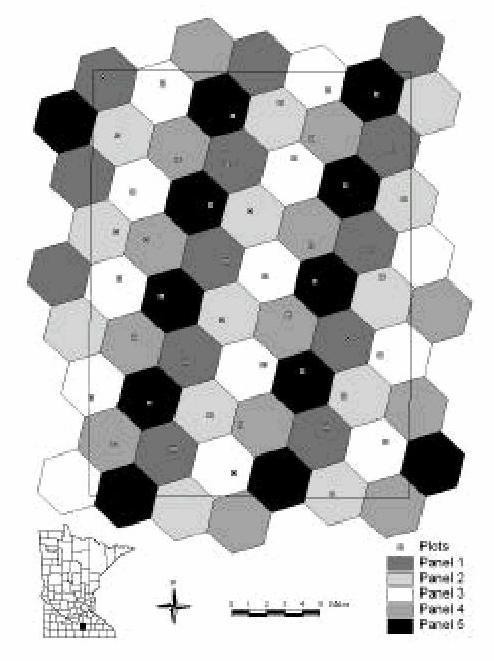
Based on experience, satisfaction of national FIA precision standards was known to require a sampling intensity of one plot for approximately every 2,400 ha (6,000 ac). Thus, the base EMAP hexagon was subdivided into FIA hexagons of 2,403 ha which served as the basis of the FIA sampling design. The sample was established by selecting a permanent plot location in each FIA hexagon and is considered an equal probability sample. The sample was systematically divided into five interpenetrating, non-overlapping panels. Panels are selected for measurement on a rotating basis with targets of one panel per year in the eastern U.S. and one 50-percent sub-panel per year in the western U.S. Figure 2 illustrates the assignment of plots and their associated hexagons to panels and the random locations of plots within hexagons.

Fig. 2. FIA hexagons, panels, and plots for Waseca County, Minnesota, USA.
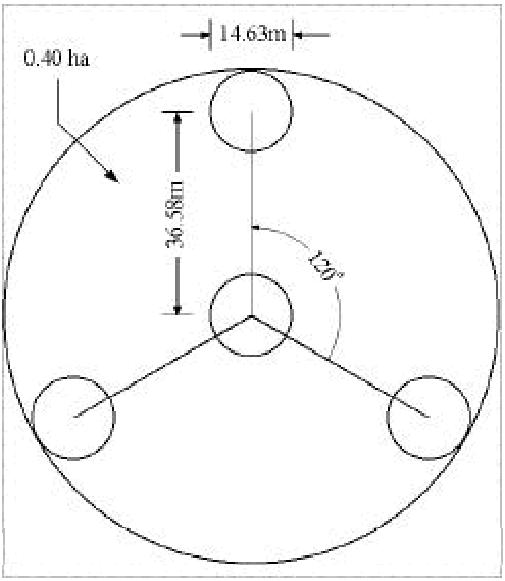
Each FIA plot consists of four 7.31-m (24-foot) radius circular subplots (Figure 3). The subplots are configured as a central subplot and three peripheral subplots with centers located at 36.58 m (120 ft) and azimuths of 0o, 120o, and 240o from the center of the central subplot. The plot configuration includes smaller components not shown in the figure for sampling other forest attributes such as small trees, non-woody vegetation, down woody material, and soils. This plot configuration is regarded as adequate for simultaneously sampling the entire suite of FIA variables.
Three-phase program
The Enhanced FIA program consists of three phases. Phase 1 entails the use of remotely sensed data to obtain initial plot observations and to stratify land area in the population of interest. Phase 2 entails field crew visits to the physical locations of permanent field plots to obtain measurements of variables such as tree species, diameter, and height. Phase 3 entails field crew visits to a subset of the Phase 2 plots to obtain measurements for an additional suite of variables associated with forest and ecosystem health.

Fig. 3. The national FIA plot configuration.
Phase 1. Remotely sensed data in the form of aerial photographs and satellite imagery is used to accomplish the two Phase 1 tasks, initial plot land cover observation and stratification. In Phase 1, analysts determine a digitized geographic location for each field plot, and a human interpreter assigns the plot a land cover/use. Plot locations with forest land uses that are accessible to field crews are selected for further measurement via field crew visits in Phase 2.
The combination of natural variability among plots and budgetary constraints prohibits measurement of a sufficient number of plots to satisfy national precision standards for most inventory variables unless the estimation process is enhanced using ancillary data. FIA uses stratified estimation to enhance the process and increase the precision of estimates. Thus, the second Phase 1 task is to stratify the land area of interest using ancillary data in the form of satellite imagery. Because FIA uses a systematic sampling design, stratified random sampling is not an option. Nevertheless, even with systematic sampling, stratified estimation may still yield increases in precision.
With stratified estimation, two tasks must be accomplished: first, each plot must be assigned to a stratum, and second, the proportion of the land area of interest in each stratum must be determined. The regional FIA program of the North Central Research Station, USDA Forest Service, uses classified satellite imagery as the basis for the stratification. With this approach, image pixels for the area of interest are classified with respect to predictions of land cover attributes into similarity classes. These classes are then used as strata, or strata are derived from them, for the stratified analyses. Strata weights are the proportions of pixels in strata, and plots are assigned to strata on the basis of the strata assignments of their associated pixels.
Phase 2. In the second phase, field crews visit plot locations determined in Phase 1 to include accessible forest land use. The field crews determine the location of the geographic center of the center subplot using geographic positioning system receivers. They record subplot-level observations of land cover, forest type, stand origin, stand age, stand size class, site productivity class, forest disturbance history, slope, aspect, physiographic class, and ground land use conditions. For each tree, field crews record observations and measurements that include species, live/dead status, lean, diameter, height, crown ratio (percent of tree height represented by crown), crown class (eg., dominant, co-dominant, suppressed), damage, and decay status. Office staff use field crew measurements to calculate values for additional variables including individual tree volume and per unit area estimates of number of trees, volume, and biomass by subplot, by species groups, and by live/dead status. The Phase 2 variables are identified in the national FIA field manual, are measured on each plot in every state by all five regional FIA programs, and are designated core variables. Additional state and regional variables may be included, but no core variable may be deleted.
Phase 3. The third phase of the Enhanced FIA program focuses on forest health. The Phase 3 sample consists of a 1:16 subset of the Phase 2 plots with one Phase 3 plot for approximately every 38,450 ha (95,000 ac). Phase 3 measurements are obtained by field crews during the growing season and include an extended suite of ecological data: lichen diversity and abundance, soil quality (erosion, compaction, and chemistry), vegetation diversity and structure, and down woody material. The incidence and severity of ozone injury for selected bioindicator species are also monitored as part of an associated sampling scheme.
The Phase 3 variables were selected to address specific criteria outlined by the Montreal Process working group for the conservation and sustainable management of temperate and boreal forests and is based on the concept of indicator variables (Anonymous 1998). Observations of an indicator variable represent an index of ecosystem function that can be monitored over time to assess trends. Indicator variables are used to address ecological issues such as vegetation diversity, fuel loading, regional air quality gradients, and carbon storage. The Phase 2 and Phase 3 data of the Enhanced FIA program serve as the nation’s environmental report card and are a primary source of reporting data for the Montreal Process Criteria.
Estimation
Stratified estimation is used to obtain estimates of population means and variances for most FIA variables. The regional FIA programs make the data for each panel available as soon as measurement, editing, and processing are complete. In addition, they report statewide estimates of core variables every five years with due dates for individual states staggered over the 5-year interval. The default estimator for the 5-year reports is a 5–panel moving average in which data for all five panels are pooled, regardless of the date of plot measurement.
The National Information Management System
The National Information Management System (NIMS) is crucial to the success of the Enhanced FIA program and consists of two primary functions, data storage and data processing. NIMS is designed to accommodate in a nationally consistent manner Phase 1, Phase 2, Phase 3, and quality assurance data. The FIA database reflects the field data collection protocols documented in the national FIA field manual and contains nationwide, tree-level data that can be acquired for user applications. NIMS simultaneously accommodates national requirements for processing core data and producing tables of forest resource statistics for both national and regional reporting requirements. NIMS is designed to be user-friendly and accessible. Input from users has been actively solicited as a means of engaging them in the development effort. In addition, NIMS provides a user-friendly interface to accommodate requests for data and data summaries and to facilitate use of a variety of software processing tools. Custom tables and maps based on FIA data may be obtained using the Forest Inventory Mapmaker Web application (Miles 2001) available online at
Summary
The Enhanced FIA program of the United States Forest Service features national consistency in crucial areas such as sampling design, plot configuration, core variables, measurement protocols, default estimators, database procedures, and reporting requirements. FIA data serves as the primary source of information for reporting on U.S. forest resources and for large-scale ecological and environmental assessments such as the Montreal Process Criteria
References
6. Research Projects and Programmes,
New Environmental Study for South Australia
David Fox, Study Director
CSIRO, Australia
A major environmental study to investigate the health and condition of the marine waters and associated ecosystem off Adelaide, South Australia was announced last year. This 4 year, $4 million study is being managed by CSIRO’s Environmental Projects Office and will draw upon scientific expertise from a number of disciplines and research institutions. The objective of the Study is to develop knowledge and tools to enable sustainable management of Adelaide’s coastal waters by identifying causes of ecosystem modifications and the actions required to halt and reverse the degradation.

The Study will focus on:
FORUM
On Statistical Ecology, Environmental Statistics And Advanced Raster Map Analysis
G.P.Patil
Distinguished Professor and Director
Center for. Stat. Ecology and Environmental Statistics
Dept. of Statistics, The Pennsylvania State Univ., USA
1. Introduction
As we are aware, effective cross-disciplinarity of statistics, ecology, environment, and society is crucial in the twenty-first century in response to the toxic legacy of the twentieth. While it is exciting that we are alive in the age of information, and while it is unfortunate that we find ourselves in the crisis of environment, it is only bliss to have the opportunity to more effectively serve the cross-disciplinary cause of statistics, ecology, environment, and society in the research, training, and outreach setting. It is important that we strengthen our efforts for constructive dialogues and productive outcomes, using forums we have and new forums we can have. These may include:
The Center for Statistical Ecology and Environmental Statistics is engaged in an initiative on advanced raster map analysis using advanced mathematical, statistical, computational and visualization approaches for sustainable environment and development. Geospatial data form the foundation of an information-based society. Remote sensing has been a vastly under-utilized resource. Even when utilized, the credibility has been at stake, largely because of lack of tools that can assess, visualize, and communicate accuracy and reliability at desired confidence levels. In a timely move the Penn State Environmental Consortium and the College Dean have together allocated tenure track Geospatial Statistics faculty position filled within this academic year. Your comments and suggestions, and involvement in any productive manner whether research initiation and collaboration, faculty position, and/or sponsored visiting research scholar will be very helpful
If you need additional information, feel free to visit:
and enjoy the surf! Particularly the Raster Map Analysis link
3. Environmental and Ecological Statistics- An International Journal
It has been simply wonderful that we conceptualized and initiated the Journal when we did. It is now ten years. Looking back, we have covered a lot of ground, and pretty well. You may visit the Journal websites:
and
The content of a Journal is as good as its authors, reviewers, and editors. I greatly appreciate the assistance, advice, and the contribution of each involved, and look forward to our march together into the millennium with some reorganized strength.
Since best help is available to those who help themselves, I urge everyone to actively consider personal presence in the Journal, and so also the presence of the Journal. In doing so, we will have made environmental and ecological statistics more enjoyable, productive, and worthwhile. For more information, see the journal web page:
4. Environmental and Ecological Statistics-An International Monograph Series
You will also be pleased to know of the new Monograph Series in Environmental and Ecological Statistics. You may visit the monograph series website http://www.stat.psu.edu/~gpp/monograp.htm . It is wonderful that we thus have a cross-disciplinary forum and springboard in place for over 150 pp monograph-size material as well.
Let us be in touch on this cross-disciplinary front of statistics, ecology,
environment, and society. I look forward to working with you on these initiatives
and more that you may have on your mind. Many thanks. And best regards.
Statistical Methodology for Assessing
the Thematic Accuracy of
Large-Area Land-Cover Maps
Steve Stehman,
State University of New York, USA
Jim Wickham,
U.S. EPA
Jonathan Smith,
U.S. EPA
Limin Yang,
U.S. Geological Survey
Land-cover maps derived from remotely sensed data have become a fundamental data source for many disciplines in environmental science. These maps are used in hydrological and carbon cycle modelling, to assess changes in forest cover, and to investigate changes in landscape pattern. A consortium of Federal agencies in the United States collaborated to produce a national land-cover map derived from satellite imagery for early 1990 and displaying 21 thematic classes at a resolution of a 30x30 meter pixel. This National Land-Cover Data (NLCD) map will be used for a wide variety of analyses, and work has already begun on production of a 2000 version.
Statistically defensible, reliable estimates of the accuracy of the land-cover labels displayed on these maps is critical information for users. The standard approach to accuracy assessment requires selection of a sample of locations at which the map attribute is compared to the true land cover at that location. Consequently, the statistical methodology applied to accuracy assessment relies heavily on classical survey sampling design and analysis. The research activity for the NLCD accuracy assessment has focused on developing a cost-effective, efficient sampling strategy. Like many large-scale sampling projects, map accuracy assessment designs must accommodate multiple objectives, limited resources, and insufficient time for planning and research. The primary sampling design problems encountered are satisfying the objective of estimating accuracy for each land-cover class (including the very rare classes) while at the same time clustering the sample to reduce the cost of aerial photography or ground visits required to obtain the true land cover. The ongoing statistical work in the NLCD project is very applied, mainly consisting of ‘technology transfer’ of standard sampling theory and methods to achieve statistical efficiency and cost-effectiveness. Methodology for simultaneously assessing the accuracy of a land-cover change map and the in-process 2000 NLCD map is also currently being investigated. Analysis related features of accuracy assessment include measures of accuracy or agreement, and spatial display and modelling of classification error.
For additional background, Foody (2002) provides a comprehensive overview of accuracy assessment methodology, and Vogelmann et al. (2001) describe the 1990 NLCD map. Two relevant websites are:
<http://www.epa.gov/mrlc>www.epa.gov/mrlc
and
landcover.usgs.gov.
For more information contact:
Steve Stehman, (svstehma@syr.edu).
Center for Integrating Statistical and Environmental Science (CISES)
Michael Stein
University of Chicago
The University of Chicago has won a competition to set up an environmental statistics center funded by the U.S. Environmental Protection Agency entitled the Center for Integrating Statistical and Environmental Science (CISES). As its name suggests, CISES will support not just statisticians, but also researchers from a broad array of disciplines, including geophysics, medicine, economics and ecology. Principal investigators initially funded by the Center come from many parts of the University, Argonne National Laboratory and many other institutions.
CISES will support research in the development of new statistical methods for addressing environmental problems and for integrating the use of statistics throughout the process of risk assessment. The Center's main objective is to advance the use of statistical methods to assess the state of the physical environment and its impact on human and ecological health. Specific research problems of the Center's initial projects include investigating the relationship between air pollution and respiratory illnesses, statistical design and analysis for estimating trends in environmental indicators, approaches to combining numerical models and statistical methods, quasi-experimentation to assess the relationship between infant mortality and particulate air pollution, and the development of stochastic models and model selection procedures for complex ecological systems. The other primary objective of CISES is to educate a new generation of environmental statisticians and statistically sophisticated environmental scientists.
The Center will initially support five projects covering a wide set
of problems in statistics and environmental science. Their titles and lead
Principal Investigators (all from the University of Chicago) are: Air
Quality and Reported Asthma Incidence in Illinois, John Frederick;
The Detection of a Recovery, George Tiao; Quasi-Experimental
Evidence of the Impacts of Small and Large Airborne Particulates, Michael
Greenstone; Integrating Numerical Models and Statistical Methods,
Michael Stein; and Model Selection and Complex Ecological Data Sets,
Greg Dwyer.
7. Recently Published Books
In this section of TIES Newsletter members are invited to provide the editors with details of any newly published books that they deem relevant for the readership.
8. Book Reviews
Liliana Gonzalez, Editor
Two book reviews are included in this issue of the Environmetrics Newsletter. I would like to take the opportunity to thank the reviewers, Nedret Billor, visiting professor at the University of Iowa and Bruce Johnston from the University of Manitoba, for agreeing to review the books with a short notice and a very tight time frame. I would also like to thank Kate Stewart from Wiley for providing the reviewers with copies of the books and making these reviews possible.
Finally, I would like to invite the members of the Society to contact
me at liliana@cs.uri.edu if interested
in reviewing a book for the Society. There are many interesting books coming
out and I would like to see a selection of them reviewed for this newsletter.
Don’t be shy, your contribution is valuable and very much appreciated.
Regression Analysis by Example
by Samprit Chatterjee, Ali S. Hadi and Bertram Price
Wiley, Series in Probability and Statistics, 1999, pp384, Cloth, US$94.95, ISBN 0-471- 31946-5.
Reviewer: Nedret Billor,
Visiting Professor, Statistics & Actuarial Science, University of Iowa, Iowa City, IA, 52242, USA. Email: nbillor@stat.uiowa.edu
I approached this review as if I were considering to adopt this textbook for my undergraduate regression analysis class or as a researcher wanting to learn more about regression. I am familiar with the previous editions of the book and if I had read this edition without knowing the title of the book, I would have not realized that it was a new edition.
The first chapter presents an introduction to what regression analysis is about and illustrates with real life examples the different areas of application in regression analysis.
Simple and multiple linear regression are introduced in the second and third chapters. Chapter Two begins with an introduction of covariance and correlation coefficient for simple linear regression. The introduction of these concepts in the earlier part of the book is appealing since it introduces the reader to the concept of relationship between X and Y in terms of these measures. It is also nice to see the emphasis on the importance of graphical procedures which highlight the fact that blind use of these measures may mislead the analyst.
In Chapter Three the authors intentionally avoided the presentation of multiple linear regression in matrix form and tests of hypotheses are presented in a clear way without the use of matrix notation. This is an unusual feature in a standard regression textbook. Because of the documented usefulness of matrix algebra in understanding the theory of Linear Models, I rather see these topics introduced in a matrix framework.
Chapter Four is devoted to regression diagnostics. This book places more emphasis on identification of outliers than most books about regression, a topic I consider essential. One always has to remember that someone’s noise can be another person’s signal! The masking and swamping effects in the context of regression analysis are emphasized through well chosen data sets.
A detailed use of indicator variables is given in Chapter Five. The use of indicator variables and applications such as comparison of means for two or more groups are nicely presented.
Chapter Six discusses transformation of variables for simple linear regression and Chapter Seven, weighted least squares for multiple regression. These two chapters have very good examples that illustrate the practical uses and underlying ideas of transformations and weighted least squares and relationship between these two approaches, their usefulness and requirements.
The major effects of autocorrelated errors in regression analysis are discussed and motivated by an example in Chapter Eight. Tests, removal of autocorrelation via transformations and limitations of Durbin-Watson are also given.
When collinearity is present among independent variables, ordinary least squares is known to be unreliable. Chapters Nine and Ten are devoted to the analysis of collinear data and alternative estimation techniques such as ridge and principal components regression are discussed.
Chapter Eleven discusses variable selection procedures and it is pleasing to see ridge regression as an option. Chapter Twelve is a new addition to previous versions and it introduces logistic regression.
Overall comments:
The emphasis in this book is on data analysis rather than inference, and discusses many interesting "real life" examples. The examples are well chosen and the exercises at the end of the chapters challenging. A lot of attention is given to graphical procedures which are great in providing the analyst with a good first "feel" of the data. Tukey emphasized the importance of graphical procedures and it is nice to see that approach in this book.
An appealing feature is that the book has a website
which contains all sort of information about the book, data sets not included in the book and detailed analysis of these data sets.
This is an excellent book for undergraduate students and researchers
who want to learn about regression analysis. It gives a clear exposition
and insightful descriptions of key ideas in regression through well chosen
examples and it is easy and enjoyable to read. It is well worth your time
and money.
Design and Analysis of Clinical Experiments
by Joseph L. Fleiss
Wiley, Classics Library Edition, 1999, pp448, Paper, US$69.95, ISBN 0-471-34991-7.
Reviewer: Bruce Johnston,
Department of Statistics, University of Manitoba, Winnipeg, Manitoba, Canada, R3T 2N2. Email: johnstn@cc.UManitoba.CA
The text's target is clinical investigators, biostatisticians in biomedical research centers and the pharmaceutical industry. It is intended for a second-year graduate level course on design of experiments. In this description the author is too modest. The text contains excellent material for intermediate and higher level statisticians regardless of their future direction in Statistics. As well, any researcher contemplating tackling a research problem could profitably gain from the descriptions of how to gather data in a sensible and controlled way.
The text assumes some prior knowledge of statistical methods. A review of basic concepts is contained in the first 5 chapters. The importance of replication and randomization is emphasized, linear regression reviewed, and completely and randomized block designs presented in these first chapters. This review material includes refreshing insights into topics not usually emphasized in a first presentation. Reliability, the impact of increased sample size and the measurement of interexaminer reliability is illustrated. The parallel groups design, a version of the completely random design, is presented and contrasted with the procedure of historical controls and nonrandomized experiments. Pairwise multiple comparisons and multivariate analysis are introduced.
Stratification is presented in Chapter Six leading to its use in multicenter studies. Stratification in a project often leads to unequal numbers of observations for each treatment within each strata. The controversy arising in the statistical literature for the appropriate analysis with unbalanced data in a 2-way analysis is covered with recommendation for proceeding, under stated assumptions, in medical problems.
The widely used topics in medicine and other areas covered in detail include covariance analysis, repeated measure designs, and Latin and Greco-Latin squares. The limitations, controversy and analysis in Crossover studies is covered. A quick introduction to balanced incomplete block designs, factorial experiments and split plot designs completes the topics covered.
Fleiss gives a very successful Fisherian description of measuring variation. He uses this concept to show the consequence of imprecise measurement, bias and methods to improve precision. These concepts are important for aspiring statisticians to grasp so they can understand and explain the results of computer analyses. Randomization is presented and its importance emphasized for the various designs. Because many clinical designs result in unequal sample sizes in the substrata, the analysis for unequal numbers is highlighted with the procedures for securing the appropriate variances for treatment contrasts. Fleiss follows, uses and praises Cochran and Cox's Design of Experiments but arguably presents clearer explanations of the meaning of many statistical procedures.
As one might expect from the author, the analysis for various designs is given when there is an ordered or nominal response variable rather than a continuous one.
What is missing if the text is used in a course? An integration of computer packages into the course would have to be done by the instructor. The text does include some explanation of results when various packages give different answers. Hand computations are emphasized to aid the explanation for what is being measured. Because of inaccuracies inherent in hand computations, they should not be generally used, as Fleiss warns.
Pairwise multiple comparisons are inset in various examples and, for the most part, not dealt with directly or given as one alternative approach. Often pairwise comparisons is not the best approach to answer a researchers question regarding treatment comparisons. A comprehensive attack on treatment comparisons, including pairwise would have been a benefit. The arch conservative Scheffe's multiple comparison procedure is often used which unfortunately leads one to the impression it is the most highly recommended one. Although linear regression, and parenthetically higher order regression, is presented the use of these in a measured treatment variable, such as dosages of a drug, are not highlighted. A brief mention of response surface techniques would be useful.
An instructor using this text should be ready to supplement these topics as well as providing data sets on which the student can 'cut their teeth'. The exercises included tend to be more derivational. They are often used to provide the detail to complete some points made in the body of the chapter.
As we enter the era where design and analysis is presented as an adjunct
to computer package output, it is important to have such a masterly presentation
of the concepts behind the computations.
9. TIES Board of Directors
The following are the names of the elected members of TIES Board of Directors. All terms are from September 1, 2000, to August 31, 2002, except the 4-year terms of the regional directors.
President: Sylvia R. Esterby
(SREsterby@ouc.bc.ca)
President-Elect: Peter Guttorp
(peter@stat.washington.edu)
Secretary: Jari Walden
(jari.walden@fmi.fi)
Treasurer: Francis J. Philbert
(francis.philbert@ec.gc.ca)
Publications Officer: Teresa Alpuim
(talpuim@fc.ul.pt)
Regional Representatives:
North America: Anthony R. Olsen
(Olsen.Tony@epamail.epa.gov)
Richard W. Katz
(rwk@ucar.edu)
Europe: Daniela Cocchi
(cocchi@stat.unibo.it)
Anders Grimvall
(angri@mai.liu.se)
Other Regions: Raymond L. Correll
(Ray.Correll@CMIS.CSIRO.AU)
Carlos Alberto de Bragança Pereira
(cpereira@ime.usp.br)
TIES Newsletter is a publication of the International Environmetrics Society (TIES). It is published semiannually, or whenever the need arises, by The International Environmetrics Society and distributed to TIES members as part of their annual dues. Contact Sylvia Esterby,
sresterby@okanagan.bc.ca,
or Francis Philbert,
francis.philbert@ec.gc.ca,
for questions regarding membership and other benefits.
Objectives of the Newsletter include (but are not limited to):
The Editors would like to encourage TIES members to submit items for publication in the Newsletter. We would like to have a very comprehensive publication that is of interest to our members by including items such as members' and regional news, Environmetrics and related conferences, research projects and programmes, book reviews, letters to the editor and articles of general interest.
We would like to thank the members who responded to our call and contributed
to this issue. It is our hope that the Newsletter will be a valuable platform
for discussion and exchange of ideas among us. We will be happy to hear
your views about the contents and style of this issue. We hope that you
will be a reader as well as a contributor.
TIES Webpage: http://www.nrcse.washington.edu/ties