1. Counting the hyphenated word as one we get the following table:
| Word length |
|
|
|
|
|
|
|
|
|
|
| Count |
|
|
|
|
|
|
|
|
|
|
We estimate the
probability of more than 7 letters in a word by 5/63.
2.Seven games: P(win 4 straight) +P (win 4 games, lose one of
games 1-4)+P(win 4 games, lose 2 of games 1-5)+P(win 4, lose 3 of
games 1-6)
= .554(1 + 4 choose 1 times .45 + 5 choose 2 times .452
+ 6 choose 3 times .453) = .61
Three games: P(win 2 straight) + P(win 2 games, lose 1 of first
2) = .552(1+ 2 choose 1 times .45) = .57
3. P(X>7)=0.001 from a binomial calculation. Either something
very unusual has happened, or the new treatment is better.
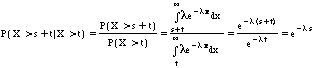
4.
5.

6. P(X2 = 0) = P(X1 = 0) + P(X1 =
1,X2 = 0) + P(X1 = 2,X2 = 0) =
.25 + .5 x .25 + .25 * .252 = .39 so P(X2
> 0)) = .61
P(X1 = 1,X2 =1) = .5 x .5 while P(X2
=1) = P(X1 = 1,X2 =1) + P(X1 =
2,X2 =1) = .25 + .25 x 2 x .5 x .25
(the second term comes from one of the two offspring having zero
offspring, and one having one) so P(X1 = 1|X2
=1)=.25/.3125 = 0.8
7. (a) There are 3 primes and 4 nonprimes, so the total
probability is 11p = 1, so p = 1/11.
(b) P(X is prime) = 3/11
8. Hypergeometric with r=8, N=10, n=5 so P(X≥4)=0.78.
No, she has to study at least 9 (then she is of course certain to
have at least 4 right).