STAT/MATH 394B
2.2.1 (a) P(HTT|HTT U THT U TTH) = (1/2)3/3(1/2)3 = 1/3
Note that this would be thae same if the coin was unfair!
(b) P(HTT| HTT U HTH U HHT U HHH ) = (1/2)3/4(1/2)3 = 1/4
This would not be the same if the coin were unfair!
(c) P(HHH | HHH U HHT U HTH U THH ) = (1/2)3/4(1/2)3 = 1/4
(d) P(HHH | HHH U HHT ) = (1/2)3 / 2(1/2)3
= 1/2
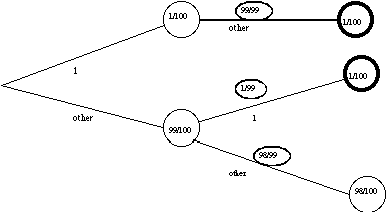
2.2.3 (a)
The probability is 1/100+1/100=2/100.
(b)
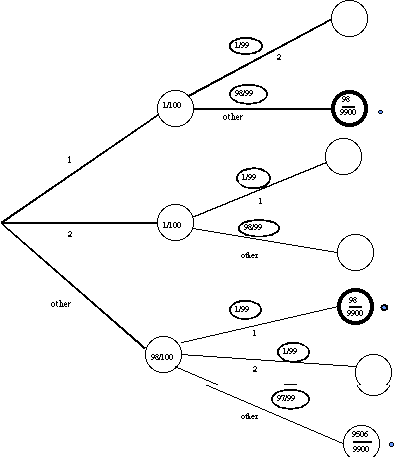
The sought probablility is the sum of the dark circles, divided by the sum of the circles with little dots, or (196/9900) / (9702/9900) = 2/99.
A simpler way to get this is to say that if we condition on not drawing the two, we just need to do part (a) with 99 possible numbers instead of 100.
(c) The probability is (98/100 x 1/99) / (98/100) = 1/99
(d) Here we get (98/100 x 1/99 ) / (99/100) = 98/992
= 98/9801
2.2.7
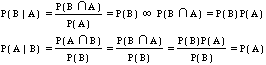
2.2.8 (a) (1/4 x 1/3)/(1/4) = 1/3
(b) no digit in proper place and 1 not first:
2143 2413 2341
3142 3412 3421
4123 4321 4312
whence the numerator is 9/24. The event {1 not first} is the complement of {1 first} so the probability is 1 - 1/4 = 3/4 (from the calculation in (a)).
(c) P(no digit out of place | 4 last ) = 1/24 / 1/4 = 1/6. The
denominator is obtained either by symmetry with 1 first, or say
that there are 3! permutations of {1,2,3}.
2.2.12 (a) 
(b) 
(c) 
(d) 
Note that (b)=(c)=(d).
(e) Here we get (b)+(c)+(d) = 
(f) Same as (e): just switch the names black and red
(g) 
2.2.13
