 ={SSS,SSF,SFS,FSS,SFF,FSF,FFS,FFF} or
{111,112,113,...,665,666}
={SSS,SSF,SFS,FSS,SFF,FSF,FFS,FFF} or
{111,112,113,...,665,666}
STAT/MATH 394B
1.2.1 (a) ={SSS,SSF,SFS,FSS,SFF,FSF,FFS,FFF} or
{111,112,113,...,665,666}
P(SSS)=(1/3) x (1/3) x (1/3) ... P(FFF) = (2/3) x (2/3) x (2/3)
(b) pX(0) = P(FFF) = 8/27 from (a)
pX(1) = 3 x (1/3) x (2/3) x (2/3) = 12/27
pX(2) = 3 x (1/3) x (1/3) x (2/3) = 6/27
pX(3) = 1/27
(c) P(X„1) = 1 - P(X = 0 ) = 19/27
1.2.10 (a) P(X = 2 , 4 or 6 ) = 4/91 + 16/91 + 36/91 = 56/91
(b) P ( X <= 2 ) = 1/91 + 4/91 = 5/91
(c) P(X = 1 or 4 ) = 1/91 + 16/91 = 17/91 (here I read "perfect square"
to mean "square")
1.2.14 (a) Yes. and w2>0.
(b) so
so  and (27/8)p(w) is a pmf.
(c)  so (1/9)p(w) is a pmf.
(d)  which cannot be rescaled into a pmf.
(e)  so (2/N(N+1))p(w) is a pmf.
(f)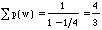 so (3/4)p(w) is a pmf.
(g)  which cannot be rescaled into a pmf.
(h) Since some terms are positive and some are negative, this cannot be a pmf.
3.1.7 (a) From 1.2.14 (a) the mass function is x2/55.
(b) P(1<X <= 3) = P (X = 2 or 3) = (4+9)/55 =13/55.